This interview is part of a series of conversations with participants of the Beyond Patriarchy Co-Learning Journey, which engages men* in learning and building alternatives to patriarchy.
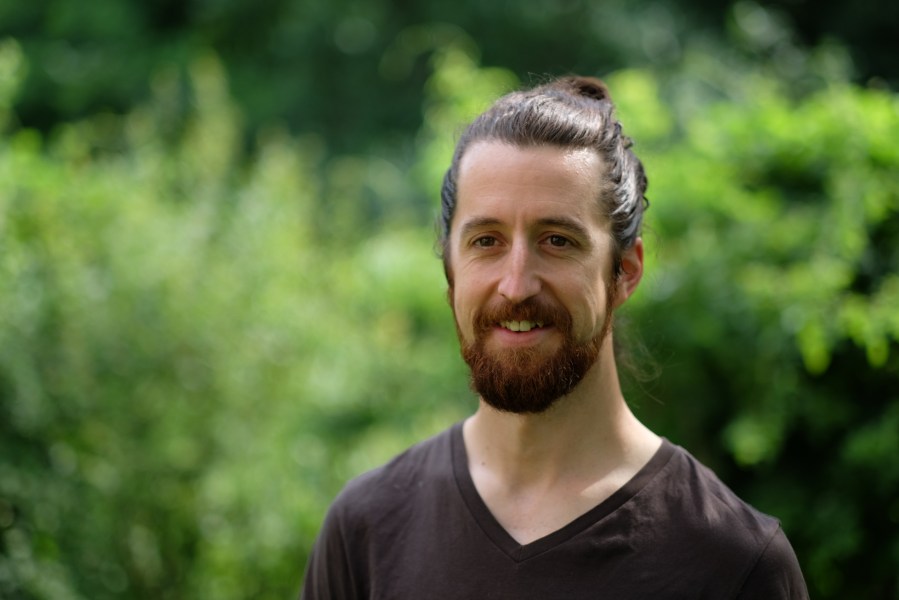
In this generative interview, Mike Romig, a participant of the Beyond Patriarchy Co-Learning Journey, shares his visions of a future free from gender norms and power over, reflects on the challenges in understanding the depths of patriarchy in everyday life, and states his commitments to this ongoing journey as part of a wider movement.
Mike Romig co-founded Purpose+Motion, the Berlin-based Transformation Agency which accompanies individuals, NGOs, social organisations and businesses to become regenerative parts of our societies and economies. With a background in human rights and peace building in Geneva, a special affinity for work in the Middle East and North Africa regions, Swiss military officer training, an MBA and coaching training, Mike is driven by a deep curiosity about the functioning of human beings and how we can again become integrated and generative actors of the planetary ecosystem we rely on. He considers his “professional” and “personal” life as equally important contributions to this “work”. Being a father of 2 young children, husband, brother to 3 siblings, son, friend, neighbour and colleague are all roles where this co-creation of a regenerative future plays out.
Imagine we’re living in a world free from patriarchy. What does that look like to you, and what was your contribution to getting us there?
What straightaway comes to my mind is a sense of a different kind of freedom – that there’s freedom for a lot of different people, not only men and women but people of any gender, to be in whatever ways they want in this world, in whatever ways they feel is right and works for them and others around them. As opposed to being restricted in who can be what way, who should do what things. It’s a larger sense of freedom.
And there’s a lot for me around power – a sense that power is shared in a more equitable way. And the sense that, again, what traditionally was often very heavily on the male side, on the patriarch side, which was dominance and power – especially power over – is much more power with. That men, women, people of any gender are able to hold power and release power, or give over power, without it being a sort of exploitative, dominating power, but instead a more generative power.
There are many different consequences that come from the current very restricted roles and expectations – all of the hurt and pain and suffering which comes from that. My hope is that one of the major changes is there would be a lot less hurt and pain and suffering because of those things. I’m sure there will always be hurt and pain and suffering for other reasons, but at least those [reasons] would be removed.
What I see as my contribution is really to be stewarding the shift of power and freedom in different relationships in different spaces.
For example, I hope men become more aware of a lot of the power over that they hold, whether they want it or not, whether they see it or not. And become aware of how they can shift that in a way that’s healthier for them and for others. And that women also find the power in themselves and around them, and are able to stand in that power in a way that is very challenging in the current environment.
And to also look at what structures need to be changed, what norms, what expectations, for that freedom to be released. Increasingly now I think it’s the work of men to feel this freedom – today there are in many ways a lot more restrictions on what a man can be than what a woman can be, socially. The social norms are very strong that a woman can be anything and should be supported. For men, there’s many social norms that still say, ‘you can’t do this, you shouldn’t do that’. And it’s very challenging to break those and move through those. It’s through both my work and my modest role modelling that example that I try to work on both those sides.
Where do you draw inspiration from to envision and construct these kinds of futures?
You, Jack! Honestly, it’s men and women who are living that, and men and women and anyone else who are daring to disrupt and change those norms. In my business lingo, with Purpose+Motion, we call them ‘Gamechangers’. It’s really people who are willing to change the game that we’re playing: change the rules, change how we play. And for me that’s it – it’s the people who dare to do things differently, to step out of the box, and not necessarily just disrupt to destroy but disrupt to create new.
I feel the space in which we’re working as co-workers [C*SPACE], that’s very much the sort of environment that’s quite quiet, quite low-key, but a very regenerative and co-creative space that’s bringing together disruptors and bringing together people who are wanting to try things differently. For me those are the people who inspire me the most – the social entrepreneurs, the leaders I see. And just general people who really are getting comfortable with being disruptors in this world and being different.
That’s not something to be ashamed of, but it’s actually something to be proud of. I can only imagine how challenging that is – I come from a lot of different layers of privilege. But people who don’t have those layers of privilege and that comfort to step into discomfort, but who’ve lived in that discomfort constantly, and still – or maybe because of – choose to say, ‘Hey, this needs to change’. That for me is deeply inspiring, and that’s where I get a lot of my energy from actually.
Thinking back over the last few months, this collective learning journey we’ve been on, what is an assumption or a belief that you’ve changed your mind about?
That’s easy, because it’s been a really big one. One of the beliefs I had going into this journey was that I was doing very well and that I was doing so well that I could help many others around me and in my life. And that this was really a sign of positivity in my own wellbeing. Which is not totally false, but what I really saw shift in this journey was the realisation that me helping others can be interpreted as very connected to patriarchy, and the norms that come from that, because it’s this sense of ‘I am better than others, I am in a better place, I can dominate through my help for those poor others who are suffering’.
What I realised through this journey and other ‘inner work’ that I was doing is that this was not necessarily coming from a place of strength, but it was coming from a place in me of hurt, fear and discomfort.
It was this sense that when I’m uncomfortable because someone else is not well, I need to help. It’s not that I want to help – it’s that I need to. And if I don’t it’s a big discomfort to me.
For me, that realisation that through helping others I was getting into a form of domination which made me feel more comfortable, that shifted a lot for me in noticing how I was creating codependency, and people around me were becoming dependent on me because I kept forcing this help, or even creating or enabling people to not be well around me, so that I could continue feeling safe, feeling detached.
That realisation showed me how the patriarchy very subtly can have people feel like they’re doing a lot of good, but actually be continuing those same patterns that have been set for decades, centuries, millennia. It takes a lot of work to notice how deep those patterns go.
That’s a nice segue to my next question, which is, how do you ensure that the changes you’re making are invested in the wider whole?
Part of it is the sharing – that it’s not an individual piece of work, it’s a collective piece. Not just with those who are on the journey, but with those who we were consciously sharing with during the journey, as part of the journey. But also just more generally, people we meet, people we discuss with.
What commitments do you hold that are important for you to honour in this ongoing journey?
The main commitment is to never feel that it’s done, that I’ve ‘got it’, that it’s fixed. To always be reflecting and self-observing, and also getting feedback from others on what I can improve and change. But doing so from a place of self-compassion as well – it’s not like I’m always broken, but more a sense of there always being room for improvement, room for things that I can do more of. I’m in a really good place and I’m really loving myself and in compassion with my own fragility, with my own imperfectness. And that’s perfectly fine.
The other is that I’m very committed to continuing this journey, not just as an individual but really being part of the movement, being part of the larger change.
So that it’s not just me doing this and saying, ‘Hey, look, I’m doing something different’. Whether it’s my children, my wife, my family, my friends, my colleagues, or more generally, that I’m really bringing this – even when it’s uncomfortable, or especially when it’s uncomfortable – into spaces as much as I can, and as much as is useful. Doing so in sensitive ways, and sometimes insensitive as well, to disrupt and really cause trouble when it’s needed. But also that it’s really bringing positive change, as opposed to simply triggering and getting reactions.
And on the flip side of this, or at least another side: for your vision of a world beyond patriarchy to become a reality, what might you still need to let go of?
One of the things I noticed very clearly, at least in myself, is that until now I still feel quite a lot of restrictions on what I can and cannot be, or do, as a man.
They’re more external appearance-related things, or more to do with sexual orientation, than how I am with people or whether I can cry. For example, wearing a dress, make up or earrings – I know still in me there’s a lot of discomfort about these sorts of things. I don’t need to do them just to be tokenistic about it. But I wonder what impact that has. For example my son, when I’m dressing him – if I’m not comfortable putting a dress on, of course I’m not comfortable putting a dress on him. Whereas my daughter, I put anything on her. What does that do as he grows up to his possibilities and his freedom?
So for me it’s not just doing things differently because it’s cool, it looks good, or it gives me social status – bonus points. But what is it that I need to work on in myself to be able, if I want to, in any situation to be whoever I want to be in that moment, and not let those preconceived judgments define that? That’s what I’m aiming to let go of.
Thank you for sharing that. What is the next step, if any, that you’re willing to take to move you in that direction?
We’re continuing the conversations I’ve been having with my wife, and with people around my kids, to ensure that for them – in particular my son – we navigate this topic very openly and be sensitive to what we’re doing, which is actually creating or reproducing this lack of freedom for him. And for me to then reflect as his father, as an example in his life. It sounds like I’m doing it just for him, but it’s also for me.
But I’m very used to this now – there’s a part of me that’s seeing things anew through his eyes. Kids are your greatest spiritual teachers! I wouldn’t see myself so strongly in my constraints if it wasn’t for him. And then continuing to explore with myself: what is it that I want or need, and that I’m not allowing myself? Four years ago I never thought I would have long hair because it was too feminine, but I love it now. It sounds small, but they’re actually very big shifts in my perception of myself – in what I’m able to embody in this world. So continue going down that route, I think.
There’s also the question of power and domination, and I’m just super interested in continuing to explore my relationship with power, and where it’s healthy to hold power and be in charge and where it’s not. And be comfortable in those different spaces, and be able to, as a parent, set rules, set boundaries. For me that question around power is absolutely crucial, and to support others to reflect more clearly on their power and privilege as well.
My final question to you. What would you like, want, or need from your community to take you in that direction?
One element is accountability. So being held accountable, or as you very beautifully put it, being ‘called in’ when there’s awareness that I’m going into power over mode.
And continued inspiration – that’s definitely an important aspect that I look for in a lot of people. Where can I learn, where can I be inspired, where can I experience the new today?
Also compassion – when I’m doing things that require me getting very vulnerable or things that I may be not so comfortable with, that in my community I’ve got people I can fall back on and talk about it with. And when it messes up or gets very scary, that’s really important for me to have my safe havens around.
It’s really important for me to keep connecting to people who are either experts or who have experience in all these topics, and to rely on that expertise and experience around how to grow myself and grow those with whom I’m working.
This interview was conducted by Jack Becher with post-production support from the Generative Journalism Alliance. To engage with stories from other participants please visit the blog.
 Beyond Patriarchy
One thought on “Beyond Patriarchy with Mike Romig”