This interview is part of a series of conversations with participants of the Beyond Patriarchy Co-Learning Journey, which engages men* in learning and building alternatives to patriarchy.
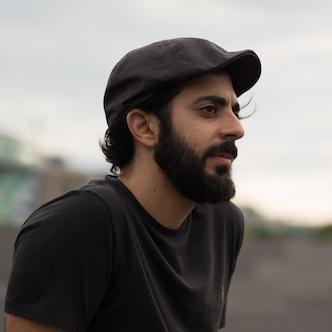
In this conversation, Marinos Chrysanthou, a participant in the Beyond Patriarchy Co-Learning Journey, reflects on pathways towards patriarchy-free futures, emphasising the importance of self-work for men and small communities of practice to create the ‘butterfly effect’. The conversation also touches critically on the nature of progress and loss of privilege.
Marinos Chrysanthou is a frontend engineer based in Berlin, where solving problems means taking long breaks to let the solutions find him. Inspired by art house films and fuelled by bouldering and dance, Marinos keeps both stress and doctor visits at bay. He once published a poem at the age of 15, a literary peak he’s yet to surpass. When not pondering why we forget summer’s sweet feeling during winter but never the reverse, Marinos navigates life between two cats who don’t get along but both love him, adding a layer of daily drama to his otherwise digital world.
Take a moment to imagine that we’re living in a world free from patriarchy. What does this look like to you, and what was your contribution to getting us there?
I tried to think a few times during the workshops what that could look like, but I think it’s a bit unfair to put ‘bullet points’ as to what I think this would look like.
During the last couple of years, I’ve been reading a lot about Eastern philosophies and religions, and actually some of them formulate this concept of: we’re not going to pinpoint exactly where you need to go, but we’re going to describe the path, and each path is going to be different. So that’s what I see in this future – it’s hard to describe exactly what’s going to be there. But I know, taking inspiration from some texts that we read during the workshops, that there shouldn’t be a lot of laws about what our society will look like in the future.
I know for sure that it should be built on respect, and that respect should be cultivated, and that cultivation requires social structures, which is a different topic. From the readings and discussions we’ve done, I believe that overloading the legal system with numerous behavioural laws is not the solution for a future society. Therefore I think this should start from smaller communities. I see this as not starting from… let’s say, this country implemented such and such laws, and now is moving towards a more egalitarian future. I think smaller communities will set an example, leading to bigger communities.
Do you want to share how you see your role in this wider transformation?
I find it hard to imagine my role within this…
That’s okay. Where else do you draw inspiration from to envision and construct these kinds of futures?
I think the first inspiration that I come back to, always when I look at a more egalitarian society or [a society] free from patriarchy, is through the eyes of a child, particularly myself when I was adolescent.
Growing up, we put up a lot of walls, constructs and ideas of what we should and shouldn’t do. A lot of us went through a tough time, including myself, to fit into those structures – [people] from all genders. It’s one of the things that became clear during the workshops.
Recently, I’ve revisited some texts we read, like the one from Varoufakis [Another Now: Dispatches from an Alternative Present], which was describing something radical. Varoufakis argues that despite significant transformations – such as the extinction of banking and the democratisation of corporations – patriarchy persists, often disguised under layers of political correctness. This perspective challenged my previous assumptions and inspired me to think more critically about the nature of societal progress.
Thinking back this time, what is an assumption or a belief that you changed your mind about over the course of this [Beyond Patriarchy] journey?
I had the assumption that women need to be included in any kind of conversation, in any process that relates to patriarchy or even sexism. But I came to realise that there is a lot of revelation that could be done by working with ourselves [as men] first.
I think step zero, as I learned, and also was a revelation for me, should be self work, as patriarchy has also caused significant harm to men. We need to understand this. We need to understand where we stand with this, where we were harmed, and then we’ll see how we may have harmed others.
With this ongoing journey, what commitments do you hold that are important for you to honour?
I definitely want to be more brave and more vulnerable at the same time.
It was something that came through the workshops. I think it was great hearing other people’s stories or seeing how brave other people were, so they could achieve breakthroughs. That’s one commitment I want to make.
Another one is: I want to read more texts about this topic, because there is not a ton of literature out there about patriarchy – it’s more about feminism. I think we need to understand… we need to gather as much knowledge [of] what we have so far, what are the ideas about this topic, so we can see what is missing, because it feels like we’re missing a lot.
When thinking about the work you’re doing, the changes that you’re making, how do you ensure that this is really invested in the wider whole?
I think there are two pillars of laying the foundations for this, for future work. One is the documentation process. I think it’s partly what we’re doing here [in this interview], but the personal documentation that we’re doing during the workshops and maybe afterwards.
The other is talking about the workshops and my personal journey with others. It doesn’t have to be going into specifics, but simply mentioning this journey could spark more interest in others.
As we’ve seen during these workshops, there is a butterfly effect. When somebody’s speaking about change or some change [is] happening within them, then others want to experience that change, or see where they could lead a different path with their actions.
Can you share a little bit more about the documentation you mentioned?
I think the first work is self work, and that self work needs to be documented, not just for ourselves, but for other workshops or other groups that want to build on the experience we had from this journey, as a blueprint to maybe step on and continue doing this work. I think documentation is key, because there is not a lot of work like this.
What might you still need to let go of to move forward in the work that you’re doing?
Definitely ego, for sure. The work that we’re doing…
We’re entering a ‘battle’ that we need to lose in order to get to the society that we envision. In a way, we need to understand that although we were harmed as men, we definitely have more privileges, or we are moving through society a bit easier than other genders.

Can you describe that more?
There is no way that we’re not going to lose a lot of privileges as men – cis men. So that is what needs to be done to reach this egalitarian society where there is no patriarchy. This is really important to understand and know when one decides to play an active part and take a role in this. It’s not great, and it will be painful. We need to understand and embrace this.
That was helpful to understand – this loss of privilege.
Loss of privilege, yeah, that’s it. I think I’ve read this in the first book we read [The Will to Change, by bell hooks] – that there is going to be an inevitable loss of privilege. So we need to know this. And I think even when we talk about this, we don’t fully understand what it will take.
What is the next step, if any, that you’re willing to take to move you in that direction?
I think it’s going to be really valuable to create a blueprint which is going to be a sum of quotes and texts that actually resonated with me, because I think whatever vision I have for myself or for society, we need to have some kind of… not commandments, but of where are we heading, what’s the future like? From that, I think the answers of what needs to be done for each vision are going to come.
In the workshops, there were some quotes on the wall that really resonated. There were some texts in the literature that really resonated. So I think I just want to write this all down, keep them as a blueprint.
Is there anything else that you didn’t have a chance to share that feels important?
Will this make me famous?
No guarantees! Thank you, Marinos.
This interview was conducted by Jack Becher with post-production support from the Generative Journalism Alliance. Stories from other participants of the Beyond Patriarchy Co-Learning Journey are available on the blog.
 Beyond Patriarchy