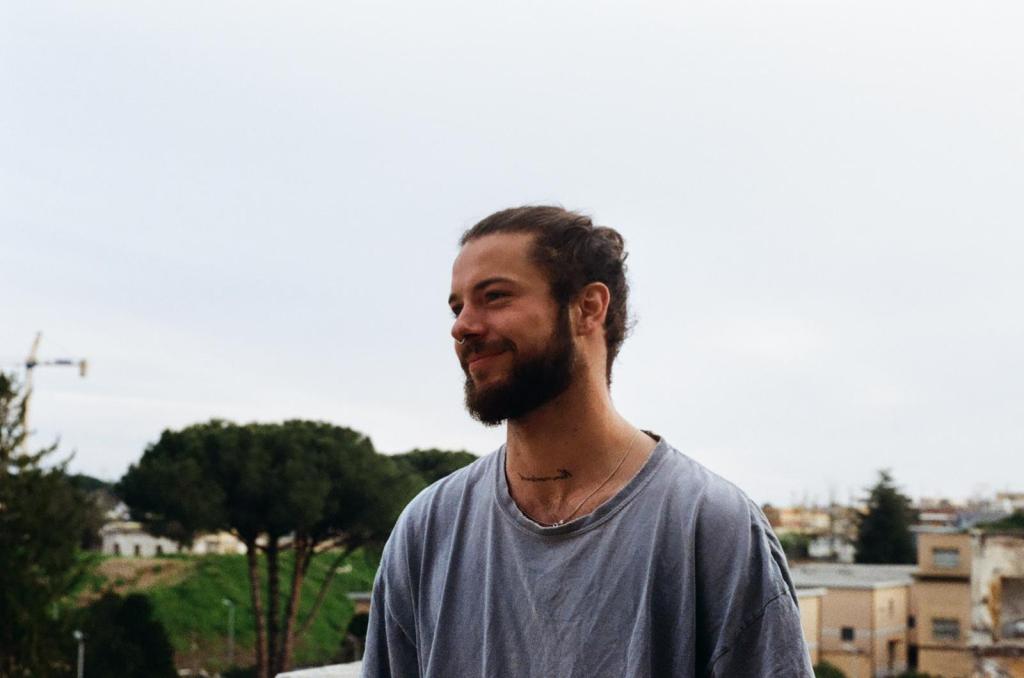
This interview is part of a series of conversations with participants of the Beyond Patriarchy Co-Learning Journey, which engages men* in learning and building alternatives to patriarchy.
In this conversation, Louis Kennedy, a participant in the Beyond Patriarchy Co-Learning Journey, shares his experience of identifying patriarchy in unusual places, ‘ego work’ and challenging male stereotypes. He reflects on the value of giving space in his life to do this deep work, despite the discomfort, and the importance of having brave spaces and relationships to make mistakes along the way.
I’d like you to take a moment to imagine that we are living in a world free from patriarchy – what does this look like to you, and what was your contribution to getting us there?
I think it’s a really complex question. Because I don’t think, as you always made a point of in the journey, we didn’t really provide alternatives. We were more thinking of possibilities. I think what I took away most from the journey, and especially bell hooks, which was very impactful, was the suppression of emotions, which especially as a man first hand I can feel. But also with my son, and because these were the two main things I was working on during the journey, with my partner and my role as a father. I think also women in relationship to men have their emotional spectrum influenced due to patriarchy. I can’t really speak for them, because obviously it’s not my experience, but in a way they are also being dictated over how to feel and how to respond to certain things.
And I would say, being the small individual that I am, as far as my horizon goes, I think it would already be a massive step if we managed to free up the emotional spectrum and the way people can feel, express feelings, and interact between each other.
That was the great thing about the journey, right? We weren’t pretending that we could solve patriarchy, but we were looking at what impact we can have.
And I think even during this journey already I started doing that, and towards my partner just being very openly emotional, or vulnerable, or embracing the vulnerability. And it has already openly been fed back to me that it’s creating space for her where she can also open up about those emotions.
Towards my son, I think it’s a bit more obvious, because he sometimes clearly asks for guidance or instructions or something like that, or comes up with some statement that really clearly falls into a patriarchal expectation, and then I can break it up with him together. So that’s very obvious. I would say that would be my contribution in my little spectrum, my little bubble of influence that I can have.
At work, I’ve become quite sensitive to male domination in a sense. Not necessarily even by positions – I work in an environment where there are a lot of non-male people in positions of leadership. But that’s the weird thing – even though the hierarchy doesn’t permit them to be at the top, the men I work with still manage to just be the loudest at the table in a discussion. So it becomes a very male-dominated discussion, and then obviously the solutions are very male-dominated. So we always have ‘male solutions’ to diverse questions, working in the humanitarian field. So professionally I try to take a step back before saying something, which I think to my character also has been quite a development.
Where do you draw inspiration from to envision and construct futures or possibilities?
Maybe this is because I’m doing therapy at the moment, but again I would say it’s very emotionally driven. It’s more action, and then what feels good in a sense. I think it just feels really good to be soft in communication, and then connection. That just reinforces every time I try it, and then it’s successful, and then it goes on. Then, obviously, if you realise it feels good to connect in a soft way with people, then that is where you want to go.
I work as a paramedic, and it’s a very overworked, burnt-out field. There’s a lot of other issues as well, but it’s also really male-dominated, so there’s a lot of ‘being tough’ and strange kinds of jokes. But it also leads to a lot of hostility, weirdly enough, in a care job. It leads to a lot of hostilities on-site, if we’re on call. I break that up. I freelance and I’ve made it a habit at the beginning of the shift to sit down and say, ‘look, I don’t get into fights and I’m not hostile’. I don’t see it as my position to correct someone’s worldview on why to call an ambulance or whatever. I’m just there to help, and I do that because within this whole context I tried that approach at work and it was really successful.
My calls are actually really nice, and I go home with a very fulfilled feeling of actually having helped people. I think the inspiration comes from being connected and being soft, and understanding that when I go into the flat of a person who called the ambulance, I am entering as a male, in uniform, which can be intimidating. And most times I have another colleague who’s a man in uniform going into a flat. If you become aware of that, and utilise the skills or the thought patterns that we worked through here, then I like to sit down and I shake patients’ hands. I don’t put my gloves on until I start working medically.
I find myself in different roles as a male, but I try to connect them all in the values I learned here. As I am a paramedic, I am also a father and a partner. Throughout this journey we’ve broken up something, and it’s nice as a man to give love and also to see it sustain and become more and multiply around me. I’d say that’s the inspiration – from a self-centred perspective, the gratification that I get from being like that.
What’s an assumption or belief that you’ve changed your mind about through this journey?
That’s a difficult one, because, as such, I don’t think I was really aware of certain thought patterns or assumptions that I had before. And to break them up and formulate new ones I’d have to know the old ones in a way. But we talked about this already in the debriefing. It’s like there are moments when you choose vulnerability, for example, and it’s not reciprocated. It does bear the risk that you always expect a response from being this way or choosing to be this way, and then sometimes, obviously it doesn’t come back, and it doesn’t always come back in a positive way. I do think it’s very easy to fall back into the old ways, just to harden up and to be like, ‘Okay, well, it’s me against the rest of the world,’ and maybe that is the assumption. It’s me against the rest of the world, which I think we all grow up with.
Here in our society, at least they’re not out there to hurt you. You know, it doesn’t matter if it’s not reciprocated every time – it’s okay. It doesn’t automatically mean that person’s out there to hurt you and you have to toughen up. With my partner, maybe one assumption that’s changed is that strength doesn’t necessarily come from distance: you don’t have to be the strong partner in that sense. With my partner, she’s fed back to me that she really likes the way I’m loving her at the moment.
I’d say it’s just holding the space – that’s all I’m doing. I’m trying to take my ego out of it and just hold space and not take the strong role I was used to growing up in Hollywood films or whatever. Where there is some form of dependence on the man taking that ego away, and that isn’t equivalent to weakness: she’s not going to run away to the next man who has more masculine traits.
But it’s a very soft, loving form of relationship that holds much more freedom and much more flexibility, but also much more warmth because it’s not a competition. It creates a sense of freedom of movement, decision-making, emotions and connection.
What commitments do you hold that are important for you to honour in this ongoing journey?
I’d say my commitment is that I hold on tight to my new-found relationship to my own emotions. I value it very strongly and I hold it in a very high position of importance in my life because I can see that there’s a lot of success in the way I move through life as long as I’m holding this and cherishing it. So when I notice that things are going wrong, I do think this has become part of my evaluation.
So I’d say my commitment is to cherish the space that I’m giving myself to work on this.
Because apart from not trying to do as much harm anymore as a participant of patriarchy, it also has a very high value to me in terms of how I’m able to live and how I’m able to move.
There’s a lot more to get out of it in a way, and of course I didn’t learn the solution to everything in this journey. I do know that I’m still contributing in ways that maybe I’m not even aware of at this point. I think the first level is always to start with yourself, and then you can try and look around. But I think with this journey we did manage to analyse our own position. I think it was a really nice journey in the sense of ‘how are we harming?’, but also, ‘how have we been harmed?’ Maybe the next journey is more focused on ‘how am I continuing to harm others?’, and ‘what can I do about that?’
So that would be the second commitment: to not let it end here, but to continue what I learnt and add to it with new perspectives.
What might you still need to let go of on this ongoing journey?
It’s the system we live in. It’s a system everyone we know is a part of. And as we talked about in the journey, it’s not just men who can contribute to it. You said it really nicely in the debrief: it’s possible to be oppressed and the oppressor at the same time. This goes for everyone.
Another sentence you said that stuck with me was about not being able to necessarily hold the complexity of it all at one time, but only being able to look at certain angles at certain points. I think admitting to that also kind of admits to the huge impact of it and how far it actually goes. I do think that in moments of insecurity, or moments when I’m not doing that well, any being resorts back to a kind of baseline instinct. It doesn’t mean you have to be doing really badly. It just means, like, a friend cancelled on me or something, and it was really important. Or you didn’t get a promotion or whatever. Things like that. Then trying to find explanations for it in a moment of weakness – I think it’s quite easy to fall back into those kinds of patterns, especially when you haven’t broken up all the entitlements and overcome your ego on certain aspects and levels. So I’d say there is still a lot of ‘ego work’ to be done within that. I think within ‘ego work’ as a man you can break open and let go to create space to embrace something else.
What, if any, is the next step that you’re willing to take on that journey?
I think ‘willing to take’ makes it sound a bit like there’s a risk to be taken. Controversially, I think there’s also the aspect that, as a man doing this work, it’s comfortable – we can determine how far out of the window we lean because we’re not being forced into this position. If we were ignorant, we could choose to just go on and not engage with this and turn a blind eye to whatever harm we’re doing. So asking, ‘what am I willing to do?’ might first and foremost refer to putting myself in a place of discomfort.
For me quite a present topic on that notion is sex and taking responsibility as a man within the topic of sex. Especially when we are talking about anonymous encounters.
I still need to work out what to do with it once I’ve reflected on past experiences and faced off, so to speak, with my own accountability. Do I approach people from the past? Then again, I feel like it might be overbearing, and you might be approaching someone who doesn’t have the need to do that. So I think even there it’s taking responsibility like, ‘Okay, I’m aware of this. I can’t just dump it on the other person again. I just have to sit with it and deal with it myself and take learning from it.’ At the moment I am not really sure what accountability and taking responsibility in past experiences look like, but it definitely has a lot to do with discomfort.
So all in all, I would say I am willing to seek discomfort to continue the work.
How do you ensure the work you’re doing is invested in the wider whole, so that it’s affecting the systems beyond your immediate experience?
Well, being perfectly honest, I don’t think I am necessarily, because it would be putting me in a position of service all the time in my daily life. And it’s like, a psychologist isn’t always going to be talking to you as a psychologist. I imagine in their private life, quite often they’re aware of a problem, but they won’t approach it with their knowledge of psychology. They’ll just approach it as a friend or as a human.
I think accepting that we are humans who have adapted to certain behaviours, and then expecting yourself to break them open at any given point, would just cause massive exhaustion, and probably a yo-yo effect – within two weeks you’d probably just be like, ‘okay, whatever, this is exhausting’. So I think it’s step by step in certain spaces, and in those spaces I would say I engage in dialogue and feedback. I’d say dialogue is probably the most efficient way to ensure that what I’m doing is working on a bigger scale.
Dialogue is probably also the way to go as a man. Being part of the dominating gender, and domination always works from top to bottom, I think we should be trying to push more from the bottom, and elevating certain paradigms and certain values by enhancing the voices of other people and affected communities.
My final question to you is, what would you like, want or need from your community to take you in that direction?
Well, funnily enough, I’ve engaged a lot with my mother in talks. It’s very interesting talking with her and my dad, because there’s a generational shift that’s very obvious from them to us but they are putting a lot of effort in to go with the times and and see the benefits. But they have their own way of struggling with it. You realise – and this is something bell hooks had in one of the chapters – about the male kind of oppression, or the oppression of their liberation. There are so many angles where that applies.
I think patriarchal work tends to look a lot at female suffering, or the suffering of other marginalised groups within patriarchy. It sounds silly because it’s patriarchy and it’s looking at men, but men tend to be a little bit forgotten – it’s either a world without men, or men should be more sensitive, but the space for that isn’t really calculated into the whole equation. It’s not about doing the work for us within that space, but rather just granting a space in which we can move to explore ourselves in a new mind-set.
That would probably have quite an impact.
With my partner for example – and this isn’t the only relationship where this is the case – critically reflecting on stuff like role expectations within sex, role expectations within arguments, role expectations within high-pressure situations, and things like that. I mean, there are very clearly defined characteristics to men that are very unwelcome, and then some that are just a little bit forgotten because I don’t think anyone’s really looking at them. And the same as any other person, men are also very complex. There’s a very big range of roles that men fulfil, and those roles aren’t one-dimensional.
So I think that’s probably the biggest thing, to just create that space in which we can explore – trial and error. Try, fail, succeed in whatever ways, because I don’t think anyone really has the solutions to everything, because it is so complex. So you’ve got a working group looking at this, and you’ve got a working group looking at that, and we could be a working group looking at something of our own.
I think probably the main thing I’ve come to realise throughout this journey is that everyone likes the idea that we’re doing this, and then everyone also has something to say about it and has something to contribute to it. I think it’s just giving this option, which worked with my partner, of going: ‘Wait a minute, can we talk about this again?’ And then she was open to it.
Thank you for sharing, Louis.
This interview was conducted by Jack Becher with post-production support from the Generative Journalism Alliance. Stories from other participants of the Beyond Patriarchy Co-Learning Journey are available on the blog.
 Beyond Patriarchy