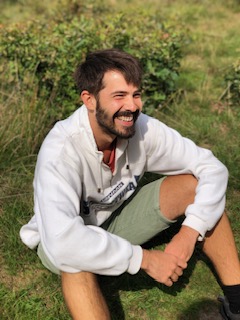
In this conversation, Lasse Hallenga, a participant in the first Beyond Patriarchy Co-Learning Journey in Spring 2024, tells us about his journey in accepting and expressing so-called ‘negative’ emotions. The conversation also touches on the experience of initiating conversations around these topics with other men.
This interview is part of a series of conversations with participants of the Beyond Patriarchy Co-Learning Journey, which engages men* in group learning and building alternatives to patriarchy.
Lasse has recently completed his studies and is now transitioning into professional life and building his career in science. He is a dedicated software developer and researcher, specialising in image processing and medical technology.
Lasse, I’d like you to imagine that we’re living in a world free from patriarchy. What does this look like to you, and what was your contribution to getting us there?
In my vision, a world free from patriarchy would be a world where people can express themselves and their emotions and insecurities freely, and that that would be something that is accepted and supported.
We had some moments in the [Beyond Patriarchy] journey together where I was like: What is my contribution? I personally find it difficult to position myself in these big picture visions. But what I’m trying to do is exactly that – try to bring myself into a position where I’m accepting myself and freely express my needs, my insecurities or, in moments where I maybe don’t feel very sure about something, that I feel like I’m expressing it. Even though my first impulse would be to gaslight myself and suppress that feeling.
Where do you draw inspiration from to envision and construct these futures that you hope to move into?
I find myself now more conscious than before. If I’m looking back, I see some patterns of exactly what I described before, this suppressing, gaslighting myself, when it comes to certain types of emotions – fear, loneliness, sadness. Those are emotions that I have had – and still have – difficulties expressing and allowing myself to feel and act on. The next thing would be sharing those thoughts with other people.
I have tried to open those conversations up with some people, and I realise that a lot of people struggle with that, especially men. In my male relationships, I try to provoke that, or push it in a direction, or just allow myself to share something. And usually something comes back as well.
I have noticed that some people have approached me differently, and sometimes even a friend starting a conversation with, ‘Hey, I’m having this difficulty,’ or, ‘I have been feeling this way lately. What do you think?’ And so on. So that gives me quite a good feeling that I’m allowing this kind of conversation between me and the other person. But also, creating a space where I feel safe to express it.
What is an assumption or belief that you’ve changed your mind about through our collective learning journey?
I was a little bit unsure about the meaning of patriarchy. I understand what Wikipedia says about it, but I didn’t really understand it. I don’t know if I do now, but I feel like I have a better sense of it. But I always thought of it as this oppression of women, and that is the focus of it, or the centre of it. And even though that is a big part of it, I, for myself, have added to the meaning of it.
As we talked about in the second [Beyond Patriarchy] session – men, especially in this emotional sense, are suppressed. What was the one statement I really liked? I don’t know if I can quote it, but ‘emotional disability’ or something like that, which I thought was kind of fitting, and also fitting to the way I’ve often felt.
“Patriarchy demands of men that they become and remain ‘emotional cripples’. Since it is a system that denies men full access to their freedom of will, it is difficult for any man of any class to rebel against patriarchy” (bell hooks in the Will to Change)
And now, looking back, I can see a pattern – this inability to express certain emotions. It moved a little bit to the centre of the problem that I see […] especially in my connection with other men.
What commitments are important for you to honour in this ongoing journey?
Now more than before, I notice this hesitation around certain thoughts and feelings, where I realised that I find it hard to express something.
So first up, I try to express my emotions and my thoughts more freely and openly. But through that, I noticed more that I have these difficulties expressing certain things, and it bothers me now a bit more, because I guess I have more awareness or focus on that. But that is something I’m trying to work on. Where I’ve realised that the most is in my romantic relationship, where I am in a lot of moments unable to express myself, and maybe don’t find the words, the language for what I’m trying to say. That is something I still try to work on.
For your vision to become real, what might you still need to let go of?
I think the first thing that comes to my mind… I think of stereotypes, especially certain emotions being ‘negative’ or not fitting into certain situations. Sadness and loneliness, or feelings considered ‘negative’ – they do have a place in a conversation. Not only in a conversation, but they have their rightful place.
I think that is something one has to let go of, to let go of this stigmatisation, and therefore this label – ‘negative’, ‘positive’. Letting this go and making it more free to express happiness as well as fear or whatever. Through that, I think, comes a lot of accepting of one’s feelings.
With that in mind, what is the next step, if any, that you’re willing to take to move you in that direction?
My initial idea is to read about it and talk about it more by myself, but also as a collective, with people around. But it sounds a little bit small, especially now that I have this wider picture in my mind.
I really liked the [Beyond Patriarchy] journey […] I think there were the ideas, the foundation was there. Even though it was a time where a lot of things were going on in my life, I think it did some stuff to me. It changed me in some ways, and the perspective that I have.
I really liked to learn more through what we did, these ‘reenactments’, thought experiments and so on. I think, by myself, I would maybe not have stuck by it. So I think something like this could be nice to re-do […] I think that that could help and put a lot of things in perspective, knowing more about patriarchy and then going back over it again, maybe discovering new things.
My final official question to you is: What would you like, want or need from your community or the people in your life to take you in that direction?
I feel like with a few people in my life I have built this kind of relationship to talk more freely about insecurities and more difficult topics. Especially for me, targeting men in my life to seek this level of communication. I would like to keep that up and get more people involved. What I described before – people come to me and that gives me a good feeling and a little bit of validation.
What exactly do you mean by this?
For instance, yesterday, I was meeting a friend, and at some point he was like, ‘Hey, I have these thoughts lately. What do you think about it?’ I thought that was a nice gesture to open the room with. Like, ‘Hey, I have this insecurity. I have these things I’m struggling with. What are your views on it?’ And through that kind of getting the validation of, ‘Okay, nice, we have created a friendship. We can talk about this.’ I think before it was not like this. So we added a layer of possible topics to talk about, and [we’re] feeling comfortable sharing things.
Beautiful. One question we wanted to return to was […] what you feel you might need to let go of?
The fear of disapproval – sticking out in a way that is maybe uncomfortable or unwelcome in some ways.
A funny example is with a friend. I was out in the evening and the conversation led in a certain direction, where we also had contact about the vision that I wrote [as part of the Beyond Patriarchy journey]. I had struggled finding a male person to express it to, but this conversation and the direction it took was very much aligned with the vision. I realised that quite quickly, but it took me ten minutes to find the courage to be like, ‘Hey, this might be really weird, but can I read you something?’ And these ten minutes – the hesitation and doubting and the insecurity of, like, ‘Okay, am I exposing myself a little bit too much? Or maybe the other person doesn’t like this, doesn’t want this.’ And so on. I think that is something I would like to let go of more and more.
I really like that you brought in courage. I think it’s a really important part of this. Is there anything you would like to add, or that feels unsaid?
I have really enjoyed having this bond with a group around a specific topic. Even though it was a little bit crazy and hazy – this time period – it was very important to me to show up.
And I really appreciated you for inviting me to it. I don’t know [about] the wider good […] but for me it sparked something, and that’s something I’m quite happy about.
I appreciate the trust you had in me to join and your commitment to it, especially when things were tough.
It was really nice. Everyone was different in their own journey, and also different personalities and so on. It was a nice and weird gathering!
That’s a good note to end. Thank you, Lasse.
This interview was conducted by Jack Becher with post-production support from the Generative Journalism Alliance. Stories from other participants of the Beyond Patriarchy Co-Learning Journey can be found over on the blog.
 Beyond Patriarchy