Part One of a two-part series on what we are learning and what is emerging in this transitionary phase for the Beyond Patriarchy project. Part Two is available here.
Over the past two years, Beyond Patriarchy has been a lived experiment in collective learning. It began with the question:
What does it take to move beyond patriarchy — not just intellectually, but in the ways it shapes our relationships, bodies, and ways of organising?
From there emerged a series of learning journeys, conversations, and shared practices with people who were willing to stay with complexity rather than rush towards resolution. What began as a question about moving beyond patriarchy has gradually become something more textured: a practice of noticing how this system lives in habits, unconscious thoughts, and imaginaries – as much ‘out there’ as in here – and of experimenting with what becomes possible when we create space for alternatives to grow.
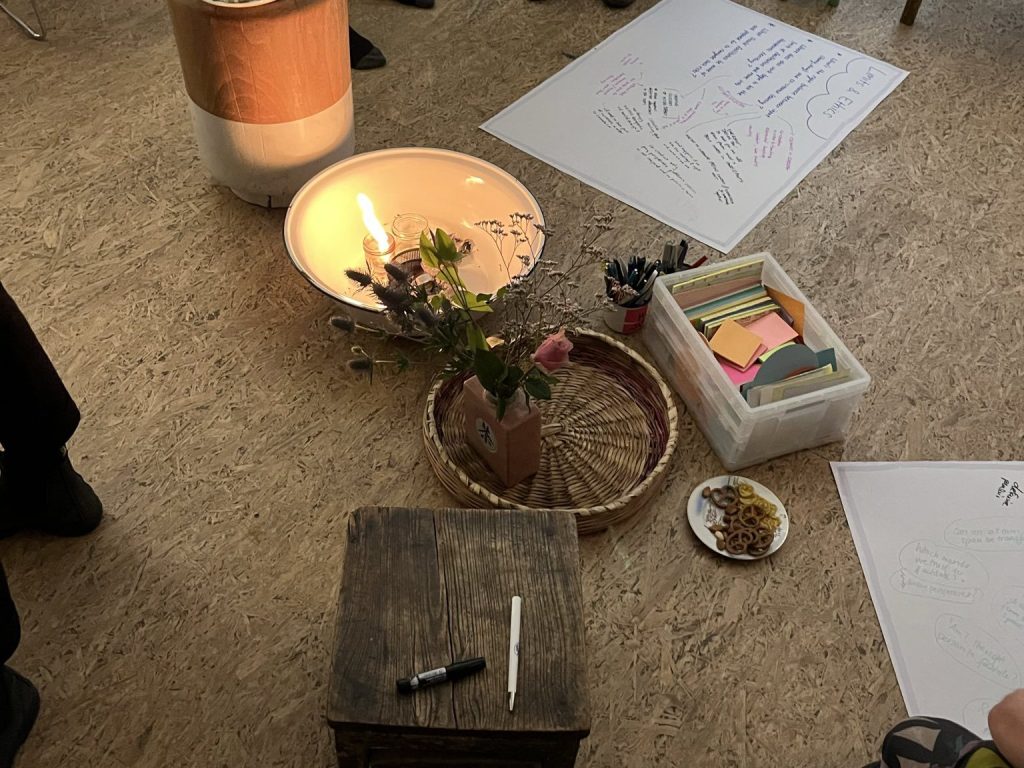
Recently, we gathered with participants, allies, and prospective collaborators to harvest what has emerged so far and to sense in what ways this work wants to grow. We were listening for patterns: what consistently supported deeper learning, where did this work feel most alive, and where did it meet its limits?
This post is part of that harvest: an attempt to name the methodological learning that has taken shape through practice, and to share it as an invitation to those who feel resonance to sense what role they might want to play in what comes next.
Situating this work
This work stands on the shoulders of many others. It builds on generations of feminist, queer, anti-racist, Indigenous, and decolonial thinkers, practitioners, and organisers — and, more importantly, on the lived labour of those who have resisted patriarchy while bearing its greatest harms. Any clarity or possibility that has emerged here is indebted to those histories, struggles, and forms of care, even where they are only partially named.
I (Jack) also want to name my own position in this. I come to this work not as someone who has ‘figured this out’, but as someone who continues to recognise its patterns in myself — in how I relate, seek validation, claim space or hide from critique. This project has been as much about noticing and unlearning my own conditioning as it has been about facilitating space for others. The learning described here is not something I’ve delivered to participants; it’s something we’ve generated together, often by confronting discomfort I would rather have bypassed. I’m grateful to everyone who has been part of this work so far, to all of those who have inspired and influenced my own journey over the years, and to the people who are now stepping in to build on this work moving forward.
12 elements: what we’re learning
What follows is not a fixed framework or series of abstract principles; these elements are distilled from practice. They reflect what participants have consistently named as meaningful, challenging or transformative across different learning journeys. They’re offered here as a way of naming what seems to matter, rather than prescribing how this work should look in every context. For the purpose of this article, we’ve chosen to name them in a more integrated way, reflecting how they are actually experienced rather than keeping them artificially separate.
Collective & Relational
That this work is collective is obvious; what becomes clearer over time is how much learning happens through relationships — by sharing stories, being witnessed, and hearing familiar patterns echoed across very different lives. Participants often describe a shift from trying to ‘figure things out’ alone towards making sense of their experiences together, where responsibility and possibility are no longer carried individually.
Embodied & Practice-Based
Learning consistently deepens when it moves beyond discussion into practice. This includes embodied reflection, relational experiments, and ‘home-weaving’ between sessions — small, imperfect attempts to apply insights in real contexts. Participants often notice that understanding only becomes transformative once it is felt in the body and tested in everyday interactions.
Systemic & Intersectional
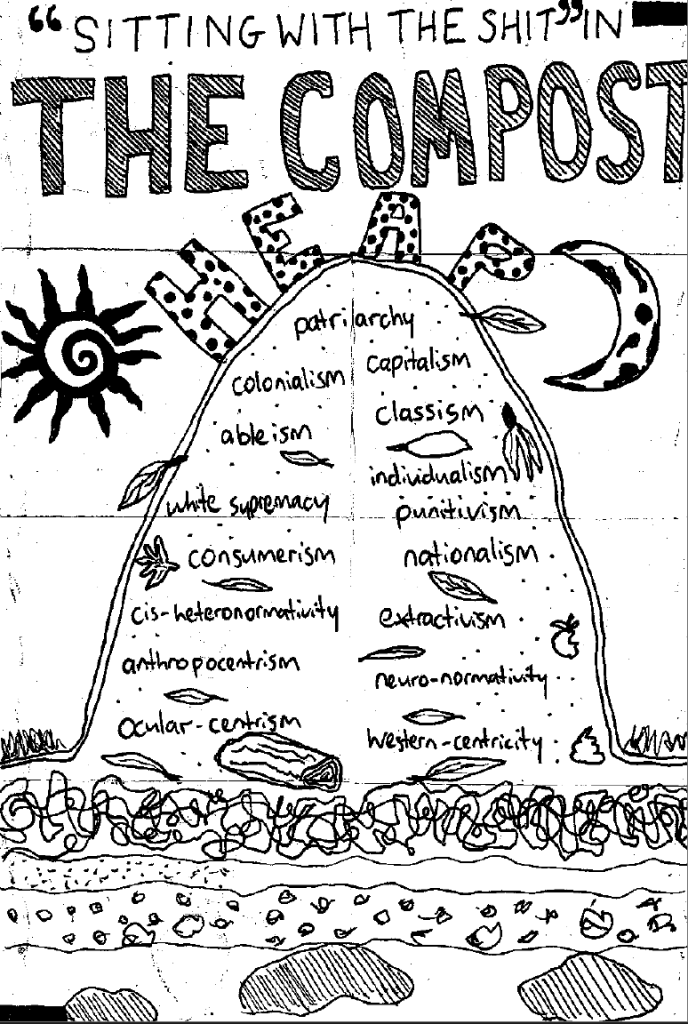
When participants begin to see themselves as entangled in patriarchy as a system — rather than as isolated individuals — shame often softens into responsibility. From there, many notice how similar dynamics operate across other systems of oppression (e.g. white supremacy, ableism, anthropocentrism). The learning becomes transferable, not because every system is explicitly addressed, but because systems thinking becomes a lived skill.
Slow & Trauma-Informed
We’ve learned the importance of slowing down — especially when the work becomes uncomfortable. By recognising trauma patterns and attachment responses, while remaining oriented towards collective meaning-making rather than therapeutic processing, participants are more able to stay present with difficulty without being overwhelmed. This creates spaces that are not comfortable, but safe enough for learning to continue.
Accountability-Oriented
This is one of the most challenging — and highest-risk — aspects of the work. In practice, it often involves naming everyday forms of harm — defensiveness, withdrawal, dominance, silence — and experimenting with acknowledgement and repair without collapsing into guilt or justification. When held well, participants describe this as building capacity for responsibility and generative action rather than shame or paralysis.
Generative
Critique alone rarely sustains engagement — never mind transformative change. We’ve repeatedly seen the importance of pairing deconstruction with imagination and action — creating space for visioning, future-self reflection, and nurturing alternative possibilities. Participants often describe these generative practices as restoring energy and agency after confronting harm, complicity or loss.
Liberatory & Gender-Situated
Rather than helping people perform their identities more successfully, this work is oriented towards liberation — transforming the conditions that make certain identities feel constrained or unsafe in the first place. Patriarchy is approached not as a problem of individual men or masculinities, but as a relational, cultural, and institutional system that we are all — in different ways — shaped by and implicated in. Many participants describe a shift from trying to ‘be better’ within the system towards loosening the system’s hold altogether. Gender is treated as a key site through which patriarchy operates, not as the endpoint of the work. While men* are prioritised in this work because patriarchal patterns are often most invisible and least questioned there, we’re expanding to reflect this systemic focus. Holding this tension remains a live ‘edge’ of this work.
What this harvest is pointing towards
This harvest has given us enough clarity to move forward with intention. Over the coming months, the focus will be on deepening this work where it has proven most alive: refining and hosting new learning journeys, developing supporting materials for new facilitators, and inviting a group of collaborators into stewardship so the work can grow in right relationship.
The aim isn’t growth for its own sake, but continuity with integrity — carrying forward what has worked, letting go of what hasn’t, and remaining responsive to the conditions and relationships that make this work possible.
If you’re a practitioner, participant, or curious ally who senses resonance here, consider this an invitation to stay close to what’s unfolding. Not because the path is fully mapped, but because the direction is becoming clearer — and because this work is, by necessity, something we do together.
This blog is part one of a two-part series on what we’re learning and what’s emerging in this transitionary phase for the Beyond Patriarchy project. Part Two is available here.
- Follow Beyond Patriarchy on LinkedIn
- Read stories from previous participants on the blog
- Find out more about our Learning Journeys
- Pre-register your interest in joining one of the next learning journeys
A non-exhaustive list of people and lineages whose work we’re building on
- Visionary thinkers such as Leticia Nieto, Vanessa Andreotti and the Gesturing Towards Decolonial Futures Collective
- Popular education scholars and practitioners such as Paolo Freire and bell hooks
- Facilitation methodologies such as Art of Hosting, Theory-U and Time To Think, as well as blended approaches such as those developed by Ulex
- Community and narrative arts approaches such as Generative Journalism, Appreciative Inquiry and Asset-based Community Development
 Beyond Patriarchy
4 thoughts on “What we are learning through Beyond Patriarchy: Harvesting two years of practice”
Comments are closed.