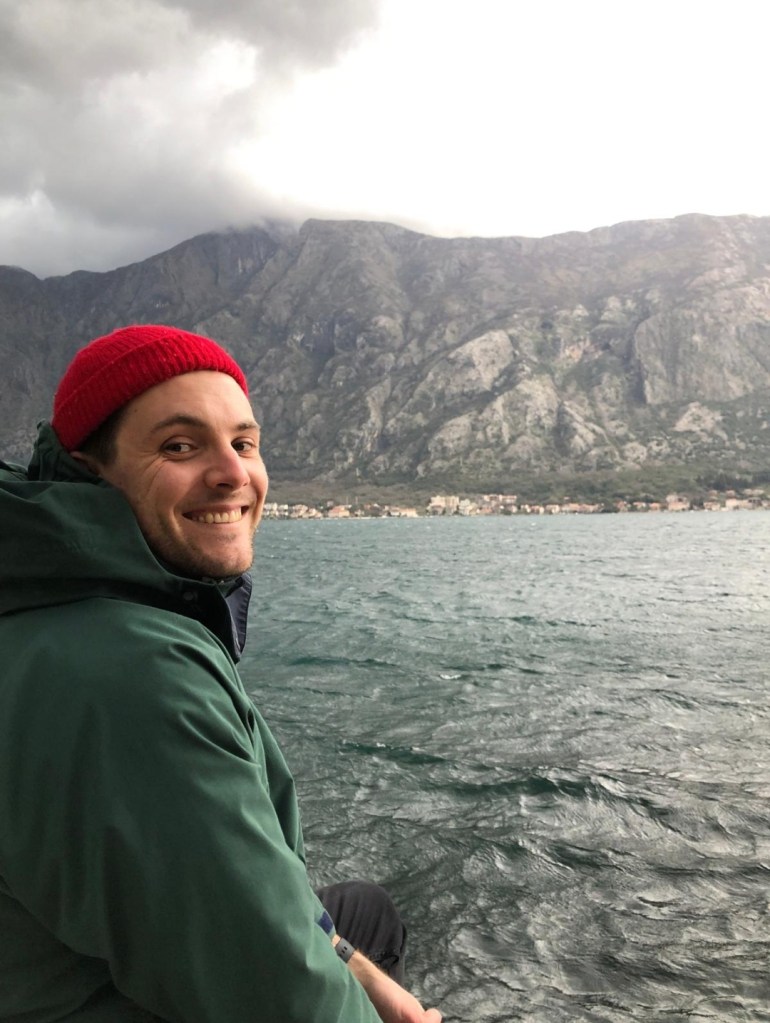
In this generative interview with Will Scobie, we explore the interconnectedness of personal practices with broader societal impacts, including the role of mindfulness in activism and the need for men to share responsibility for building a world beyond patriarchy. We also explore the importance of cultivating openness, curiosity and a willingness to ‘sit with the shit’ as part of this longer journey of co/re/un-learning.
This generative interview is part of a series of conversations with participants of the Beyond Patriarchy Learning Journey, which explores how patriarchal systems shape our lives, relationships, and ways of organising — and what it takes to unlearn them in practice.
Will Scobie grew up on the unceded lands of the Brinja-Yuin on the south-east coast of so-called Australia. With a background in architecture and urban design, his curiosities converge around commoning and regeneration, particularly the intersections with social, spatial and ecological justice. In a space of transition, his focus is currently on technopolitical networks supporting commons co-governance and co-production.
Will, let’s start this conversation where we ended the learning journey. In our final session, you were invited to ‘plant a seed’ that you commit to nourishing moving forward – what seed did you plant?
Yeah, the ‘seed’ that I planted was a commitment to meditation.
One of the biggest lessons from the learning journey was recognizing the importance of connection to body, mind and spirit, and how it’s impossible to actually separate us as individuals from the broader whole.
Understanding our own emotions and being able to manage and control our nervous systems is actually a very radical act of care in and of itself – and an act of solidarity – because in managing our own feelings and understanding them, we have so much more capacity to help others.
So this is something that has been re-emphasized through the learning journey, especially through the grounding activities where we actually had space to be more attuned to our mind, body and spirit.
Let’s explore that more. How do you see this ‘seed’ that you planted playing out at different scales, from the deeply personal out to the wider societal?
I think it’s impossible to separate the personal and the whole – this sense of interconnectedness is very important to understand.
The importance of self-practice in terms of mindfulness, and enabling ourselves to dedicate space for this, creates so much more space for ourselves to then act in solidarity with others. I see this at a personal level in understanding my own relationships with others, being more present, and having the capacity to resolve conflict in much more aligned ways with my own emotions. But also understanding that presence is a sense of relationality too, so by seeking that as a focus for myself, that radiates towards others.
I’ve been very grateful to see activist spaces actually involve mindfulness. This is what the parallel journey Zen and the Art of Saving the Planet really tries to combine – the importance of activism and spirituality together. It’s not selfish to be focusing on this – it’s actually an act of care for the rest of this interconnected web. I think that only compounds outwards from the personal, to all the different more-than-human beings, our interpersonal relationships, to community, and then bioregional, transnational and eventually planetary.
Beautiful. I know you’re already doing a lot in this direction, but what is the next step that you’re willing to take to nourish this seed?
I’m very excited to be exploring different ways in which this learning journey can be continued and expanded to include more people.
At a personal level, it is about confronting people within my social context, and then expanding into community such as looking at activist circles and exploring how this can be a political framework.
Understanding the importance of having space where this is a focus, not only for men to be complementing the work of FLINTA* in supporting intersectional feminism, but also having spaces of critical discussion with men.
And what might you still need to let go of or ‘compost’ for this to flourish?
A lot of things! I think it’s a journey that probably won’t ever have an end.
One of the biggest things to let go of is the tendency to be self-reliant and independent. This is something that I’ve sought comfort in throughout most of my life, and embracing the discomfort of asking for assistance from others, and also accepting that from others.
Accepting the harm that I cause and continue to cause is still a process that will be composting. And also accepting the harm that has been caused by other men in my life, and processing that.
I think this balance between taking on responsibility, but also not taking up space – this is something that I’m still trying to question the boundaries and the peripheries of.
Where is the balance between contracting into spaces where just men are discussing certain elements, and including many more voices for understanding those boundaries?
Yeah, that’s a really live question in this work at the moment. In this regard, what is a commitment that is important for you to hold?
I think the most important commitment is maintaining openness and solidarity, and embracing discomfort, because this is a space where growth occurs:
A willingness and curiosity in co/re/un-learning the various systems of oppression that I’m shaped by and also contribute to.
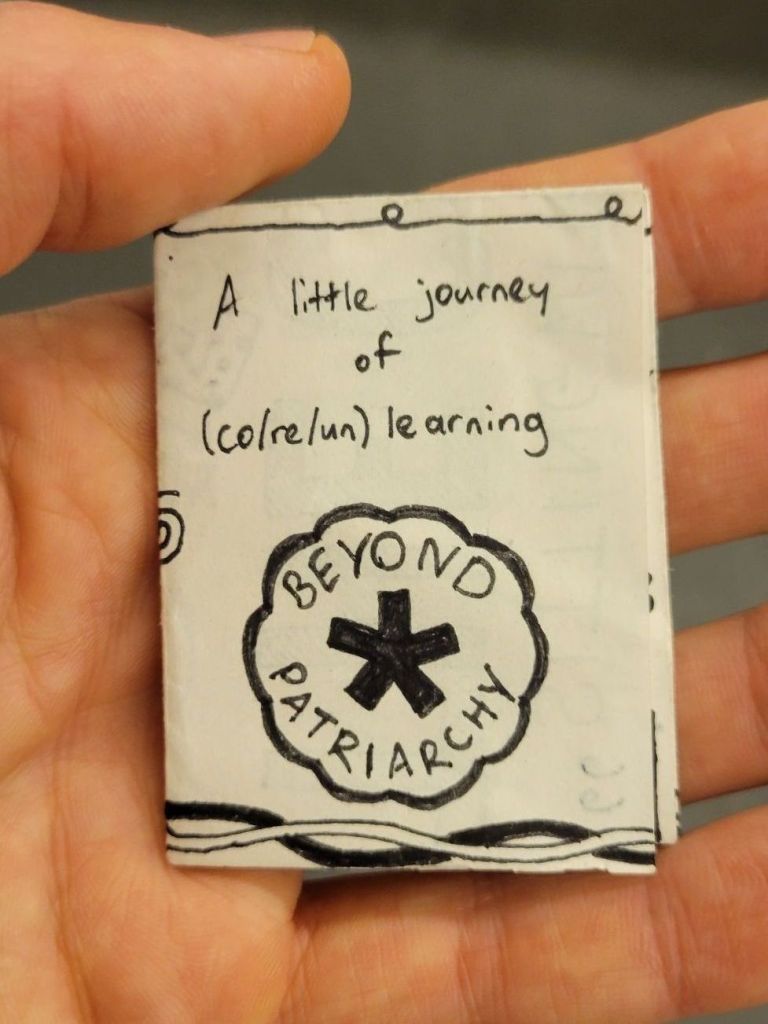
And that intersectional feminist voices are amplified. This work is about amplifying those voices and being in solidarity, but also holding space for contraction and expansion in different ways. I think that commitment is in recognizing the interconnectedness of all these systems of oppression. So the commitment to seek a world beyond patriarchy is also connected to many other different struggles – that’s a commitment of solidarity.
I was so grateful for the inclusion of intersectional feminist voices such as bell hooks in also identifying patriarchy not only as patriarchy, but as ‘imperialist, white-supremacist, capitalist patriarchy’.
What’s an assumption or belief that you changed your mind about through the learning journey?
One of the biggest assumptions that I had is that it’s not possible for men to convene about these topics alone. And we’re not alone, because the voices of others are very much present in these spaces. But I think creating brave spaces where men can confront these topics and hold each other accountable is the power of those spaces. And to more evenly distribute labor – it’s a requirement that we take on this work.
I think one of the biggest surprises was finding resonance with other men, and recognizing that this was probably the first time in my life where I was in a space where just men were discussing these topics. Of course, I’m very grateful for the many women that are present in my life who have guided my journey through intersectional feminism. But to recognize and be quite shocked that that wasn’t the norm beforehand, or that these spaces don’t exist, was actually quite a strange realization. I’m still confused why this isn’t normalized. At 29 years of age, this is one of the first times I’ve had this experience.
On that note, what might your invitations or ‘asks’ of other people and groups?
To embrace connection. To recognize the various identities, privileges and inequities that shape us. And to embrace lived experiences, and find greater attunement with those experiences.
Responsibility is a term that I’m carrying with me as well, and understanding that everything is interconnected so we carry certain responsibilities. But I believe it starts with understanding our own bodies, minds and spirits, then trying to frame that in a broader worldview.
What else might you need or want from your community or people in your life to continue nourishing that seed and move towards the visions you’ve shared here?
Openness and curiosity. I think we live in a world where many people are overwhelmed by the amount of information – and of course the cluster fuck poly-crisis – that requires a certain openness and curiosity.
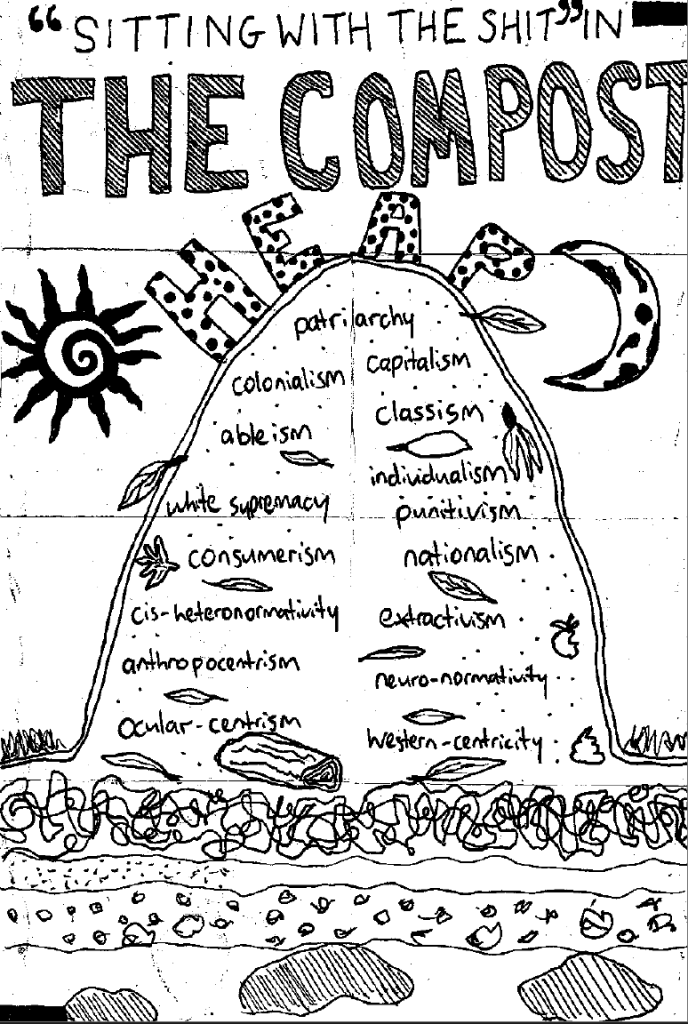
It also requires a willingness to actually ‘sit with the shit’, as we talked about in the learning journey (a phrase from Vanessa Andreotti and the Gesturing Towards Decolonial Futures Collective). A willingness to embrace that discomfort, to look beyond our own lives, and see the much larger tapestry of life that we’re interconnected with.
Speaking of relating, these conversations are opportunities to build relations between people and groups who are exploring similar questions. Who else are you aware of who you see doing valuable work in this direction?
First and foremost, this learning journey has been complemented by various other journeys and interactions, particulaly the work of Sarj and Alice in Facilitating Dialogue in Times of Rupture, co-organised by fellow participant Maksim, which also involved grounding techniques and mindfulness, and reiterated notions of harm that we were also exploring in parallel.
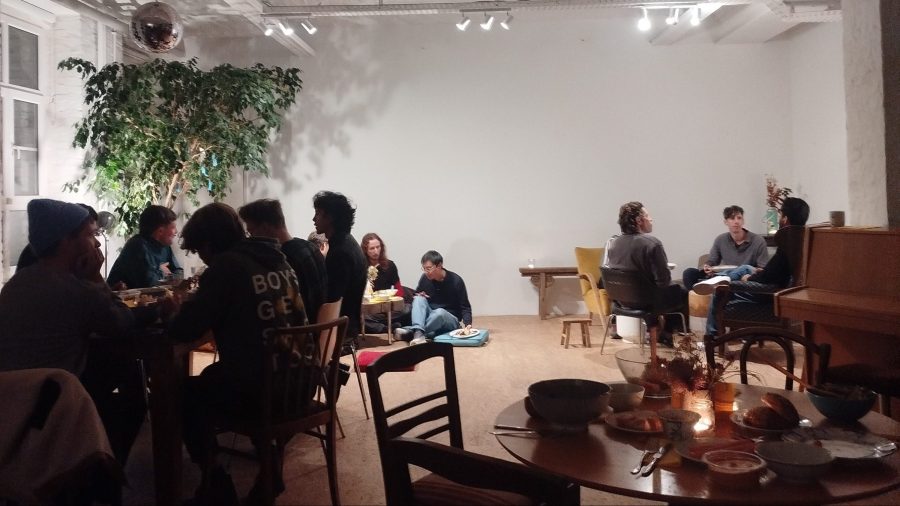
I am still reflecting on the Shared Table Dinner co-hosted by Monika Jiang, yourself, and Jindy Mann, and the space created and nurtured to enable 25 men to embrace discomfort, vulnerability and emotional connection with a sense of togetherness.
If we’re imagining worlds beyond patriarchy, I think recognizing that matriarchal contexts do also exist, and that there’s much more to learn from from Indigenous knowledge systems and ancestral wisdom. There was another parallel journey by Dr. Lyla June Johnston, including an amazing framework that she introduced called the ‘seven r’s’, embodying values of Indigenous regenerative ecological design.
Others include feminist struggles in the context where I grew up, particularly Aboriginal and Torres Strait Islander matriarchs – such as Gunnai, Gunditjmara and Djab Wurrung woman Senator Lidia Thorpe and her staunch resistance against colonial-patriarchal structures in the context of so-called Australia.
As well as many of the FLINTA* people in my life who I seek inspiration from across different circles, particularly intersectional feminists within DiEM25 and MERA25.
Isn’t it lovely to have so much hope and inspiration guiding us?
It sure is! I only have one more question for you Will, and that is: what meaning, if any, was created for you through this conversation?
I think the power of storytelling, particularly as a way of trying to communicate experiences.
I’m very grateful for the question of asking about other inspiring voices, recognizing the various voices that have influenced us and continue to influence us. And I’m grateful that this was present throughout the journey, recognizing the immense tapestry and history that is with us.
I extend my gratitude to all those that have come before us and continue this fight. But also to you, Jack, for creating this space and being a role model – to see the integrity with which you hold this space, the various elements that you bring in, and the intentions behind – it is quite powerful. So I’m grateful to be in your presence, because I think this is such important work.
That’s lovely to hear – thank you, Will. And the learning goes both ways – it’s a privilege to be alongside people on these journeys, which I’m also very much on myself.
This interview was hosted by Jack Becher with post-production support from the Generative Journalism Alliance. Stories from other participants can be found over on the blog.
 Beyond Patriarchy