Beyond Patriarchy sits in a slightly awkward place economically — it is not therapy, nor is it a ‘service’ or a publicly funded programme. It is a small, carefully-held collective learning space that asks people to show up with attention and responsibility over several weeks. And we are still learning what it means to resource work like this well.
This article shares how we currently think about financial contributions: what they are, what they support, why we hold them as negotiable, and how we arrived here.
The work to date
For the first two years, the project ran without any external funding or expected financial contributions. Most of the labour of designing sessions, facilitating, writing reflections, holding follow-up conversations, and coordinating the project was unpaid.
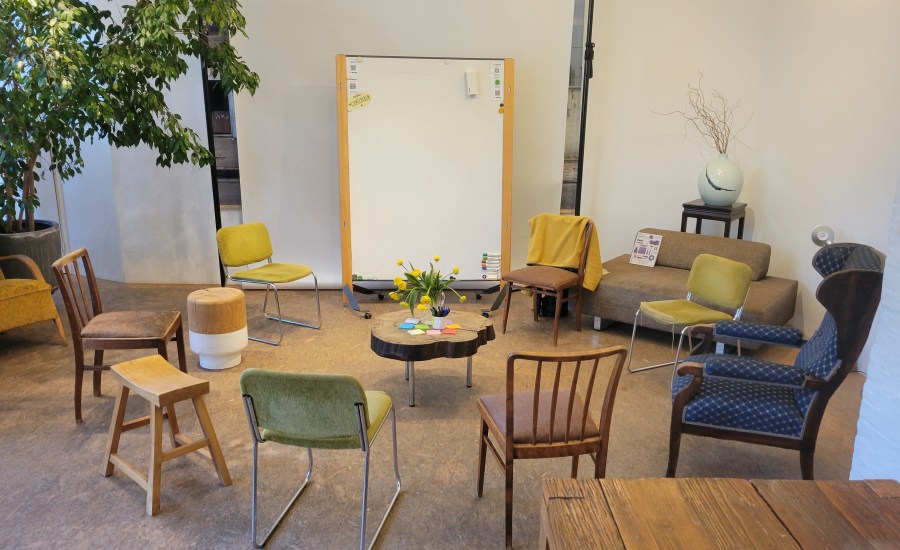
This was a deliberate choice in order to lower the barrier to participation while we learned what the work actually was. We are fortunate to have had supportive partners during this early stage: such as C*SPACE providing a physical space in Berlin for the learning journeys, Democratic Society supporting with partnerships and outreach, and many others who have helped to shape the learning and these important early steps.
Nevertheless, in practice this still often meant people working evenings and weekends alongside other jobs. Making something accessible by absorbing the costs internally is not a sustainable model. Over time it simply shifts the burden elsewhere, usually making the labour invisible. This is a pattern we see here as well as across the field. But if this kind of work is to continue and grow, it needs to support itself.
What the contributions are
Currently, we suggest a sliding scale, based on our best estimate of what the actual costs of this work include:
- €200 — supported rate
- €300 — sustaining rate
- €400+ — supporter rate
The scale exists because people have very different financial realities. At the same time, we recognise that even the supported rate is too high for some. This is why we keep a small number of ‘free’ places each round and invite people to reach out if money is a barrier to access.
Additionally, we consider financial contributions as one way of supporting the work, but not the only one. People also contribute through outreach, space caring, and other forms of support. If you feel connected to the work but unsure how to participate, we are open to conversation.
What the contributions actually cover
A learning journey is not only the hours spent in sessions, but includes:
- design and preparation
- integration and follow-up
- coordination and communication
- writing and publishing reflections that feed wider learning
- supporting new people to become facilitators
Alongside this sit ordinary project costs: digital tools, physical material, insurance, accounting, and the simple fact that facilitators need to pay rent and live.
Some of the labour is also not always visible: holding emotional and relational safety, preparing carefully for what might emerge, or adapting sessions throughout the journey to fit the particular needs of the group. The contributions support the attention required to facilitate this kind of work responsibly.
The contributions are a way of sharing the conditions that make the sessions possible.
Accessibility and sustainability
We are constantly balancing two real risks, which many of us working at the edges of systems are familiar with: if contributions are too high, some people who would benefit cannot join; and if contributions are too low, the work quietly disappears, or is carried out only by people in economically privileged positions.
These risks — and the tensions between them — are things we try to hold consciously through sliding scales, supported places, non-monetary agreements, and transparency about costs. There is no stable solution to these tensions. We revisit them repeatedly — adjusting, experimenting, and learning from each round. We hope that by making the role of money visible and negotiable, we can navigate these risks and tensions more carefully together.
Working inside the system we’re questioning
We also know that these questions belong to a wider transition. We exist within an economic system that doesn’t appropriately value deep cultural and political work — work that often questions the same patterns of extraction and competition found in our economic system. Many of us are searching for ways of organising care and learning beyond purely transactional economics. We see this as a crucial step in a larger economic transition. However, we are not there yet.
For now, we live in a space between worlds: trying to resource the work responsibly, while imagining forms of support that may one day make conversations like this unnecessary.
Until then, transparency, shared responsibility, and ongoing dialogue are the best tools we have. This is why we keep the model adjustable — contributions may change as partnerships, funding, or other forms of support emerge. We invite you to think with us about how this work can be sustained, financially or otherwise. If you have thoughts, questions, or ideas about resourcing work like this — whether as a participant, collaborator, or supporter — we would genuinely like to hear from you.
We don’t expect to get this exactly right. What matters to us is keeping the question open, visible, and shared — so that the way the work is resourced becomes part of the learning itself. By sharing this publicly, we hope to contribute to a more honest and collective conversation around money and value within social change work.
 Beyond Patriarchy